Showing posts with label Kakutluan. Show all posts

Monday, May 4, 2009

Punch of savage beauty: Pacquiao taking a historic victory with a devastating left to the chin that hospitalised the Englishman.


Good night: Manny Pacquiao ends Ricky Hatton's pound-for-pound dreams with this left-hand


Flat out: Hatton lays motionless after being knocked out by Pacquiao


Hatton heads to the canvas after yet another huge blow from Pacquiao


Crying game: Hatton's mother Carol can't look as fiancee Jennifer is hugged by a friend


In your face: Hatton takes a pounding by Pacquiao


Ruthless Pacquiao looks down on defeated Hatton after his second round knock out

Wednesday, April 1, 2009

The Japanese Looting of Asia in World War II (Part 1)


You may not know it, but there are literally billions in gold, statues and other Asian looted treasures buried in hundreds of secret locations throughout the Philippines right now. No, this is not some wild, imaginative fiction story written by a bored author on a Sunday afternoon. The story you are about to read is based on years of research, interviews and fact. Absolutely, no fiction involved.

During World War II, Japan’s militarism became a heady mixture of glory and greed as the army and navy embarked upon a binge of conquest and looting, from which Tokyo could not extricate itself. We know a log about the conquest, but amazingly little about the looting. In the Japanese holocaust, millions were killed and billions were stolen, but the loot vanished. One of the great mysteries of World War II is what happened to the billions of dollars worth of treasure confiscated by the Japanese Army from a dozen conquered countries.

The program was overseen by Emperor’s brother, Prince Chichibu and much of the plunder was secreted away in the Philippines. “Recognizing after the Battle of Midway in June 1942 that the war was going badly, a number of imperial princes devoted the rest of the war to hiding the loot ingeniously to give Japan a hedge against disaster. This systematic campaign of looting and hiding treasure, codenamed Golden Lily, was under the direct supervision of Hirohito’s brother Prince Chichibu. Until now, he was assumed to have spent the war on medical leave from the army, recuperating from tuberculosis at a country estate beneath Mount Fuji, nursed by his wife. In fact, he traveled all over occupied China and Southeast Asia supervising the collection of plunder, using hospital ships to carry much of it to Manila for onward shipment to Japan. From early 1943 til mid-1945, he was in the Philippines overseeing the hiding of this loot in bunkers, in vaults beneath old Spanish churches and in vast underground tunnel complexes. Golden Lily stripped Asia of currency, gold, platinum, silver, gems, jewelry, art treasures and religious artifacts, including more than a dozen solid gold Buddhas, each weighing more than a ton. According to Japanese who participated, some $100 billion worth of gold and gems was hidden at more than two hundred sites in the Philippines when it became physically impossible to move the loot to Japan. We have corroborated accounts from eyewitnesses and participants, including Japanese, and members of Prince Chichibu’s personal retinue.”

The wealth looted by the Japanese during World War II was instrumental in financing the resurrection of the Japanese economy after World War II. “Faced with Allied invasion of the Home Islands, and the total destruction of Japan’s heritage, Emperor Hirohito was finally persuaded to opt for a quick surrender. This was a bitter pill, but it allowed Japan to survive the war with the bulk of its assets intact, including billions of dollars of loot that would help put the nation back on its feet. Since the war, the gold hidden in a number of sites in the Philippines has been recovered by teams from Japan and other countries, and these recoveries have been verified. A Swiss court disclosed in 1997 that one of the solid gold Buddhas is now in a bank vault beneath Zurich’s Kloten Airport, along with a large quantity of other gold bullion recovered by former Philippine president Ferdinand Marcos and held in Marcos family accounts. In 1997, a Japanese investigative team from Asahi Television was taken to an underground vault in Luzon where they filmed (and took core samples of) 1,800 gold bars worth $150 million - gold that was stolen from Sumatra, Cambodia and Burma. This gold had been melted down in occupied Malaya, recast and marked in accordance with the accounting procedures of Golden Lily, and then sent to Manila on fake Japanese hospital ships. Treasure looted from China was taken to Japan by way of Korea and hidden in underground vaults in the mountains near Nagano, the site of the 1998 Winter Olympics. Gold bullion aboard ships at the time of surrender in 1945 was sunk in Tokyo Bay and other points along the coast, and some of it has since been recovered.

The successful recovery of this wealth was realized in considerable measure through the deliberate subversion of attempts at reforming Japanese political and economic life after World War II. “Thanks to Prince Chichibu and Golden Lily, when the U.S. occupation ended in 1952 ‘bankrupt’ Japan was able to begin a ‘miraculous’ recovery, on its way to becoming the world’s second-richest economy. War reparations were dodged, the imperial family evaded punishment, and Japan’s financial elite resumed control as if the war had not occurred. Claims that Japan and its imperial family were left virtually penniless by the war would therefore appear to be completely false. War loot also provided a huge pool of black money used by postwar politicians to corrupt Japan’s bureaucracy, bringing the country full circle again at the millennium to the verge of economic collapse.

For decades after the war, the existence of this hidden treasure was regarded by many as sheer fantasy. It served Japan’s purpose to have people think so, while recovery efforts went on secretly. Because the Japanese General, Yamashita Tomoyuke (a.k.a.-The Tiger of Malaya), was in command of the Philippines when it was invaded by the Americans, these hidden treasures have become known as Yamashita's Gold or the Tiger's Gold. Shortly following the end of World War II, Yamashita was tried for war crimes and hung in the Philippines. He never disclosed any of the secret locations of Asia's buried looted war treasures.

During the earlier part of the war W.W.II looted treasures were being shipped back to Japan for badly needed war finances. However, when American patrolling naval vessels made the shipping of these looted treasures to Japan much too risky to continue with due to almost certain loss, another plan was devised.

Investigative reports show that a great bulk of World War II treasures reached the Philippines from the latter part of 1943 through October, 1944, at that period when Field Marshall Count Terauchi was in charge of the Japanese Imperial Forces in the southeast area of the Pacific. He had ordered Admiral Masaharu (then over-all military commander of the Philippines before General Yamashita) and several other admirals and generals (including Yamashita) that all war booties taken from their respective occupied territories comprising Java, Sumatra, Singapore, Malaysia, Thailand, Burma, and Northern India be collected and thereafter transferred to the Philippines.

Japan had always considered the Philippine Islands to be a very important strategic location for military bases in Southeast Asia. Unknown to the rest of the world, the Japanese had a major plan for post war sovereignty, and the Philippine Archipelago was included in this elaborate scheme. Once the shipping lanes became too dangerous due to American Naval vessels, almost all of the loot that the Japanese had accumulated thereafter was being channeled to the Philippines and buried. Their ultimate plan was that when the war was over they were going to withdraw forces from all the other Asian countries, but try to maintain there colonial rule over the Philippine Islands.

Under the banner of "Asia for Asians" they prescribed some reforms in the guise of nationalism. In hopes to win over the Philippine people, in 1943, the Japanese went as far as setting up a "Philippine Republic" and installing a puppet government with the Judge Jose Laurel as president. By winning over the hearts of the Philippine people and later even granting them independence, the Japanese hoped that they would then be regarded as "heroes" by them. This would also allow them to put military bases there as a pretext of "protection for the Philippine people". In this way, they could remain in the Philippines for as long as they liked and take their time to re-excavate the stolen W.W.II loot at their leisure. It was a good plan but in the end it didn't work out--the Americans invaded the Philippines in October 1944.

However, before this U.S. invasion, the Japanese were very busy hiding and securing its Asian W.W.II loot. Elaborate tunnels were dug, some down to depths of a few hundred feet, to the final "storage chambers" where the gold was to be kept. Most, if not all of these tunnels, were booby-trapped and rigged with 1,000 and 2,000 pound W.W.II bombs and poisonous gas. This trick would help deter the buried loot from falling into enemy hands. Detailed maps of the sites were drawn up on rectangular rice paper--all written in the 2,000 year-old Japanese script known as "Kungi", which hasn't been used for the past 150 years. Numerous concrete markers, which were to be left as clues, were also buried at strategic locations that would later lead the looters back to the hidden caches. These markers were in the shapes of different animals and had Kungi writing on them.

In most cases, POW labor was used to dig the intricate tunneling systems. In all cases, upon completion of securing the gold in the pits...the POWs were all executed and buried along with the treasures. In some rare cases, Japanese officers even had their own soldiers killed and buried along with the treasure to protect their secret locations.

In all there were 172 "documented" Philippine burial sites (138 land and 34 water sites) left by the Japanese. This is not to even mention the numerous "private" burials of W.W.II loot by greedy officers and renegade soldiers. There was still much treasure remaining to be buried when the U.S. abruptly invaded the islands. Japanese forces took all of this with them up into the mountains in the northern Philippines and other areas during their retreat, where it was all buried at many different locations.

It is estimated that the total worth of this war loot ranged up to three billion 1940's dollars--the equivalent of over $100 billion today. According to various post war estimates, the amount of gold bullion alone was 4,000 to 6,000 tons. Top U.S. and Japanese sources claim that it would take at least one hundred years to unearth all of these hidden treasures.

If you're wondering why the Japanese themselves haven't gone back to the Philippines to try and secretly recover some of this hidden booty, the answer is: They certainly have...but only a very small percentage of what was actually buried! Ex-president Ferdinand Marcos himself managed to recover several sites (with the assistance of some ex-Japanese soldiers) and that is how he became so wealthy.

However, Malaysia was force to hire investigators to secretly follow traces of Japan’s loot from Malaysia. Decades and millions have been spent to draw out detailed and specific imperial sites of Malaysia’s treasures in different parts of the Philippines. When the riches of Malaysia overheard of the stealth recovery by the Malaysian Government of the hidden treasures, riches kidnapped several investigators forcing them to reveal the sites in the Philippines where the stripped Asia of currency, gold, platinum, silver, gems, jewelry, art treasures and religious artifacts, including more than a dozen solid gold Buddhas, each weighing more than a ton where hidden.

Part of which a billion dollar wealth (chiefly gold bullion, platinum and gems) was hidden in caves and large quantities of bullion at sea, deliberately scuttling ships including the cruisers, sunk with all hands by a Japanese submarine that then machine-gunned all the Japanese crew members who came to the surface.

Ekran Berhad is a Malaysia-based investment holding company engaged in the provision of management services to companies in the Group. The Company is organized on a worldwide basis into investment holding and project management, trading and extraction of timber, construction and property development, oil palm plantation, air transportation and related aerial business, gaming, and hotel business. Its subsidiaries include Ekran Project Management Sdn. Bhd., Ekran Logging Sdn. Bhd., Ekran Timber & Sawmill Sdn. Bhd., Ekran Plantations Sdn. Bhd., Langkasuka Marina Development Sdn. Bhd., Maya Mewah (M) Sdn. Bhd. and Interstate Budget Resort Management Sdn. Bhd., among others Rumored to have recovered billions of treasure underlying Paet Straight, covert their operation by constructing a multi-billion tourism estate while other intelligence officers backed secret recovery operations that netted huge sums. The gold was slipped into the market cautiously to avoid affecting world gold prices. These recoveries continued intermittently over the years.

End of Part I

Monday, March 23, 2009

the truth about the Battle of Mactan

random stuff i learned from school…

According to recent studies and research, Lapu-Lapu, the ripped Cebuano we all know who kicked Magellan's ass in battle of Mactan….
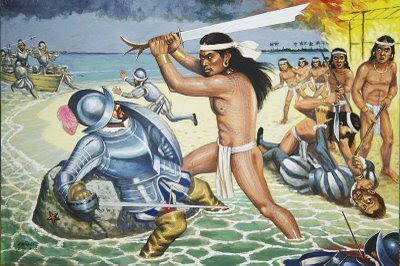


….is in fact a fat old datu who never stood from his throne.


The fearless datu who supposedly drove the final kill with his mighty Kampilan (30-inch badass sword forged by Filipino blacksmiths) into the invader's neck actually did not even participate in the battle itself.

Note: the Battle of Mactan is the only battle in Filipino history where we actually WON. all battles after this, we all got our asses kicked.

The facts of the battle:

Ferdinand Magellan was an old soldier and never commandeered a ship prior to the command of the Victoria. He first approached the Portuguese government to grant him a fleet that he needs to "pursue the greater glory of the kingdom" or more accurately, his dreams of conquest. But the throne denied him of his request due to several political incidents in his military years. But this did not stop the old soldier in realizing his dreams. He then went to Spain to ask the government of the same thing. For some reason, he either thought it was genius to approach the primary competition of Portugal in world domination or he was just plain desperate to get his fleet.

Eventually, the Spanish throne under Charles V granted him 5 dilapidated and creaking vessels: Santiago, San Antonio, Conception, Victoria and Trinidad. His mission was to establish a link between the Spice Islands and Spain. Not to conquer anything. Just to make sure that Spain had access to the spice islands. By this time you should see that luck was really not on this guy's side. When the Portuguese heard about this, the Portuguese king ordered for the ambush and capture of Magellan. He was considered a traitor to his country. Thus their expedition was hampered by several times they had to evade the angry pursuing Portuguese fleet. On his way to Asia westward his crew conducted two mutinies. In the Pacific, they landed on an island named Ladrones (which meant land of thieves) and had another unfortunate incident because the natives stole their supplies and some of their small boats.

In the Philippines, he made a political alliance (immortalized by the famous blood compact). He promised the chief of Cebu (Humabon) to aid him in his war against the chief of Mactan (Lapu Lapu) Big mistake. The mission clearly stated that the relationship remain economic and not political. They say Magellan did this because he had an agenda ala Hernan Cortez

The rocky waters of Mactan failed to give the galleys of Magellan the desired shore landing they wanted. about 50 Spaniards disembarked in full battle armor (almost 50lbs?) , in waist deep rocky waters, hundreds of meters from the beach, where almost two thousand (yes, 2000) Filipinos are shouting, screaming and taunting the poor Spaniards. A few soldiers had to remain to guard the small boats as Magellan and his troops try to shoot the "natives" with their cross bows and muskets. and since 16th century ballistics technology does not offer sniper-like functions and the accuracy of a modern rifle, firing for almost 30 minutes (the projectiles did not even reach the beach or hit anyone) the Spaniards soon wasted their ammunition. (Plus the water practically made their cross bows useless because it got wet.) Magellan then sent 2 Spaniards to the Mactan tribe to supposedly burn the houses down. (another big mistake since the houses were built on light materials and could easily be rebuilt, so another nonsense) they managed to burn a few houses before the women of the tribe was able to capture them and killed them. By the time they were near the shore they were greeted by a signature Filipino combat maneuver (commonly found riots in urban areas). imagine 2000 people throwing rocks, sand, spears, pots, practically anything they can be called a projectile in unison to 30+ men. total disaster for Magellan. and after the first barrage of rocks, sand, pots, etc. the same thousand rush to the 30+ poor Spanish soldiers and tear them to pieces. Lapu Lapu was no where to be found.

2000 against 36 men… no wonder they lost. ambot lang ug mapildi pa plus homecourt advantage pa gyud.

Prior to this knowledge, for some reason, i always pictured Lapu Lapu looked like Gardo Versoza.

Wednesday, February 25, 2009

STROKE IDENTIFICATION


 STROKE:
Remember the 1st three letters....
S.T.R.


Please Read The Story:


During a BBQ, a friend stumbled and took a little fall - she assured everyone that she was fine (they offered to call paramedics) .....she said she had just tripped over a brick because of her new shoes.

They got her cleaned up and got her a new plate of food. While she appeared a bit shaken up, Ingrid went about enjoying herself the rest of the evening.

Ingrid's husband called later telling everyone that his wife had been taken to the hospital - (at 6:00 pm Ingrid passed away.) She had suffered a stroke at the BBQ. Had they known how to identify the signs of a stroke, perhaps Ingrid would be with us today. Some don't die.... they end up in a helpless, hopeless condition instead.

It only takes a minute to read this...

A neurologist says that if he can get to a stroke victim within 3 hours he can totally reverse the effects of a stroke... totally. He said the trick was getting a stroke recognized, diagnosed, and then getting the patient medically cared for within 3 hours, which is tough.

RECOGNIZING A STROKE

Thank God for the sense to remember the '3' steps, STR. Read and Learn!

Sometimes symptoms of a stroke are difficult to identify. Unfortunately, the lack of awareness spells disaster. The stroke victim may suffer severe brain damage when people nearby fail to recognize the symptoms of a stroke. Now doctors say a bystander can recognize a stroke by asking three simple questions:

S * Ask the individual to SMILE.
T * Ask the person to TALK and SPEAK A SIMPLE SENTENCE (coherently) (i.e. It is sunny out today)
R * Ask him or her to RAISE BOTH ARMS.


New Sign of a Stroke -------- Stick out Your Tongue


NOTE: Another 'sign' of a stroke is this: Ask the person to 'stick' out his tongue. If the tongue is 'crooked', if it goes to one side or the other, that is also an indication of a stroke.